The next AI race is not just smarter models. It is governed work.
Found Friday · Season 5 · Issue 2
Anthropic’s Claude Fable 5 launch is a useful signal for business leaders: the market is moving from chatbots that answer questions to agents that can work longer, handle messier context, and require much better boundaries.
What I’m seeing this week: the frontier AI companies are no longer just announcing faster chatbots. They are announcing systems that can plan, code, read complex documents, use memory, interpret screens, and keep working across longer tasks. That is exciting, but it also makes the boring parts more important: permissions, data retention, logging, approvals, fallback plans, and clear human ownership.
The pattern
Models are getting better at long-running work, not just short answers.
Vendors are adding access tiers, safeguards, and trusted programs because some capabilities are genuinely risky.
Businesses need workflow governance before they hand real operations to agents.
Top Story · Anthropic / Claude
Anthropic launches Claude Fable 5, a public version of its Mythos-class model
Summary: Anthropic launched Claude Fable 5, its most capable generally available model to date. The company says Fable 5 is strongest on long and complex tasks, including software engineering, knowledge work, vision, scientific research, and memory-heavy agent workflows. Anthropic also launched Claude Mythos 5, the same underlying model with some safeguards lifted, but restricted to vetted users through Project Glasswing and trusted access programs.
Why it matters
This is not just another model bump. Anthropic is showing where frontier AI is headed: models that can work longer, reason over messier materials, and operate more like project assistants than answer engines. But the more capable the model gets, the more the operating model matters. Anthropic is routing high-risk categories such as cybersecurity, biology, chemistry, and model distillation away from Fable 5 to Claude Opus 4.8. That is a product decision, but it is also a governance lesson.
What to do now: Do not treat frontier models as automatic defaults. Pick one high-value workflow, define what the model can access, where human approval is required, how cost will be measured, and what evidence proves the work was done correctly.
Follow-up · Anthropic / Claude
Anthropic suspends access to Claude Fable 5 and Mythos 5 days after launch
Source: Anthropic — Jun 12 update, confirmed still suspended as of Jun 17
Summary: Anthropic suspended access to Claude Fable 5 and Claude Mythos 5 on June 12, days after launch, following a US government export control directive. As of June 17, access remains unavailable with no announced restoration timeline. The incident has become a case study in the regulatory and operational risks of depending on frontier AI models.
Why it matters
This is the part of AI adoption leaders need to hear. A model launch is not the same thing as a production-ready workflow. If your team builds around a brand-new model the week it ships, you inherit the vendor’s safety, capacity, policy, and reliability issues — plus, as this case shows, regulatory exposure. The continued suspension, now nearly a week later, proves the point: frontier AI access can disappear overnight, and there is no guarantee it comes back quickly.
What to do now: Treat new frontier-model releases as evaluation candidates, not immediate operating standards. Test them on contained workflows, keep a fallback path, and do not promise customers or internal teams a capability until it has survived more than a launch-week demo. Also document where your users, data, and use cases sit relative to potential regulatory boundaries — the next access restriction may not be voluntary.
SharePoint / Copilot Governance
SharePoint governance gets more Copilot-specific with Authoritative Sites and Agent Access Insights
Summary: A June Microsoft 365 roadmap roundup points to two practical SharePoint governance moves: Authoritative Sites, which lets admins mark trusted SharePoint sites as preferred sources for Copilot Chat and Copilot Search, and Agent Access Insights, a planned heatmap for spotting agent activity patterns across SharePoint and OneDrive.
Why it matters
This is a better business story than another enterprise AI rollout. Microsoft is acknowledging the real Copilot problem: not whether AI can answer questions, but whether it is answering from the right content and whether IT can see what agents are touching. If your official policies sit beside stale drafts and abandoned project sites, Copilot needs a trust signal. If agents are moving through sensitive libraries, admins need visibility before a governance issue becomes a leadership issue.
What to do now: Identify which SharePoint sites should be treated as official sources: HR policies, procedures, leadership updates, safety documents, customer-facing content, and current department guidance. Then assign owners. A trusted-source feature only helps if the source stays trustworthy.
SharePoint / Microsoft 365
Copilot in SharePoint pushes AI closer to everyday business content
Summary: Copilot in SharePoint is expected to bring AI-assisted creation and content interaction into SharePoint sites, pages, libraries, lists, and chat experiences.
Why it matters
SharePoint is where many organizations store important content — and also old, duplicated, over-permissioned, and poorly owned content. AI does not fix that. It makes the quality of your content and permissions more visible.
What to do now: Review high-value SharePoint sites before AI features become everyday tools. Start with permissions, stale content, ownership, and sensitive libraries.
Google / Agentic Enterprise
Google keeps building toward the agentic enterprise
Summary: Google is pushing Gemini Enterprise, Workspace Intelligence, agent platforms, and cloud infrastructure as a connected business AI layer.
Why it matters
Microsoft, Google, OpenAI, and Anthropic are converging on the same endpoint: AI inside the work systems. The difference will be less about who has the flashiest demo and more about which platform fits your data, identity, security, and workflow reality.
What to do now: Evaluate AI platforms by the operating layer: identity, connectors, auditability, admin controls, and whether the system can be limited safely.
Field Notes from My AI Workstation
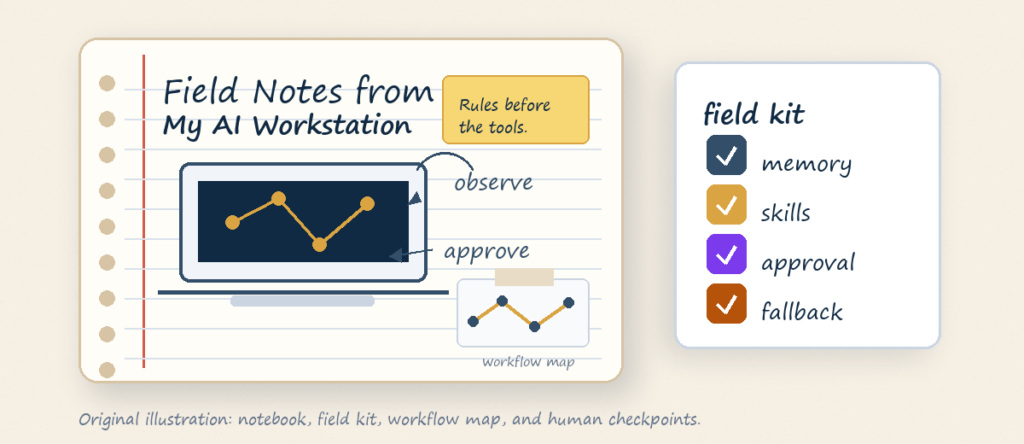
My own AI workstation journey started earlier this year with OpenClaw. That was the first time the idea felt bigger than a chatbot: an agent that could use a browser, remember context, and start working across real tools. But as the work became more operational, the needs changed: persistence, approvals, scheduled jobs, skills, safer handoffs, and a way to run the same assistant across CLI, desktop, and messaging. That is what pulled me toward Hermes.
Since early May and into June, Hermes has become less of an experiment and more of a working system: morning prompts, Microsoft 365 monitoring, local dashboards, agent skills, cron jobs, backups, smoke tests, and clear approval boundaries. The point is not to build a one-off AI setup. It is to connect AI to real workflows carefully, with permissions, logs, fallback plans, and human checkpoints.
“The future is not just smarter prompts. It is governed AI operations.”
Closing Thought
Fable 5 was the headline. The pause is the lesson. AI is moving into longer, messier, higher-value work, but even the strongest tools can hit launch-week limits. That means the old advice, “try a few prompts and see what happens,” is not enough anymore.
If an AI tool can touch real work, it needs real rules. Not bureaucracy for its own sake. Just the same practical discipline we already expect from people, systems, and vendors: know what it can access, know what it changed, know who approved it, and know how to recover if it goes sideways.
Found Friday is a practical AI signal briefing for business leaders. Each issue cuts through the noise to focus on what changed, why it matters, and what to do now.