
AI agents are getting hands. Most businesses still have blindfolds on.
The new AI fight is not about who has the cleverest chatbot. It is about which systems can touch your data, trigger your workflows, write to your tools, and still show a human exactly what happened.
What I’m seeing this week: The hype cycle wants us arguing about which model is smartest. The real story is rougher: AI is being wired into the places where work actually happens, and a lot of companies are about to discover they never built the brakes, mirrors, or dashboard. If an agent can touch your data or move work forward, “we trust our people” is not a control plan.
The pattern
- AI is moving from “answer this question” to “touch this workflow.”
- That shift exposes the weak spots companies used to hide: messy permissions, unclear owners, missing logs, and no clean stop button.
- The advantage will go to teams that build the control layer before the agent starts taking action.
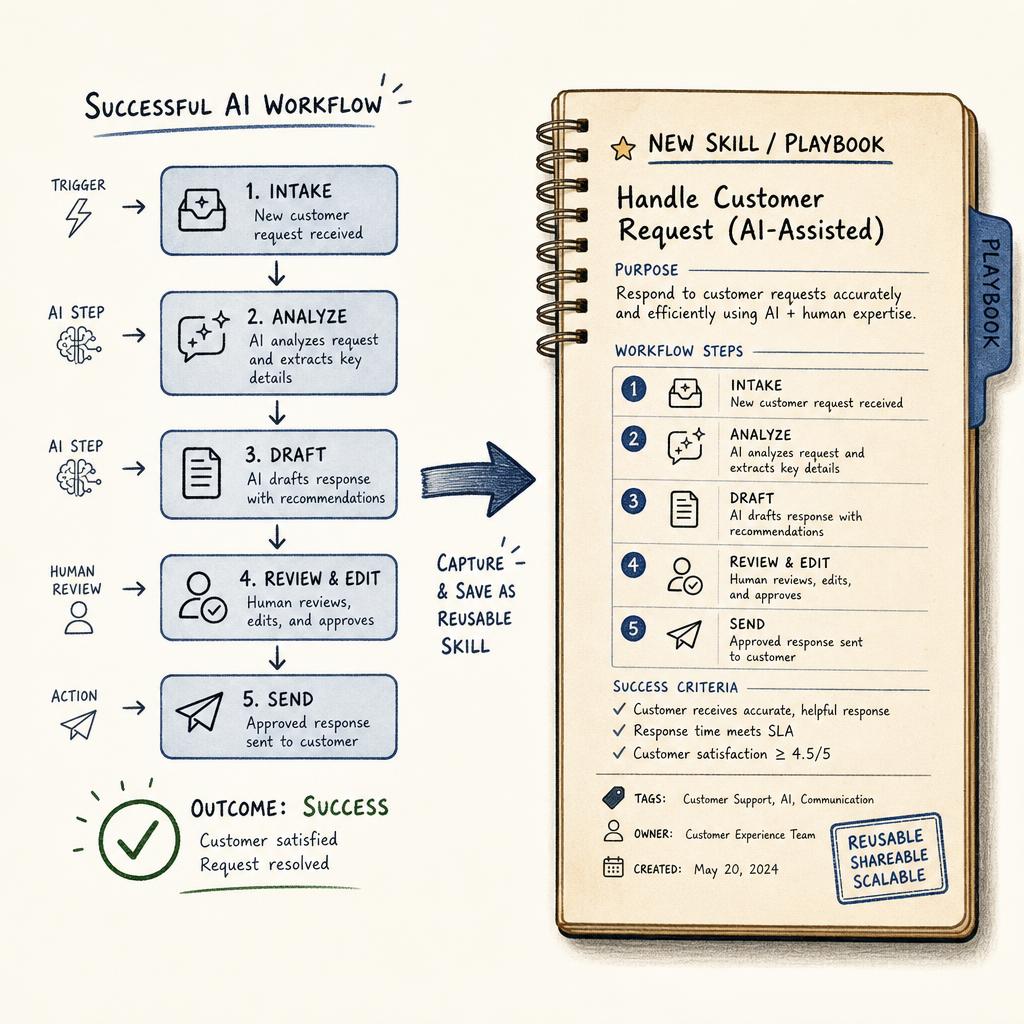 OpenAI + Anthropic / Model Economics
OpenAI and Anthropic both moved frontier AI down the cost curve
Sources: OpenAI, “Introducing GPT-6 Sol and Luna”; Anthropic, “Introducing Claude Opus 5.5”; OpenAI model documentation; Claude Platform release notes.
Summary: Verified: the second release was Anthropic. OpenAI introduced GPT-6 Sol and GPT-6 Luna on September 22, bringing the GPT-6 family into cheaper, higher-volume work. Anthropic released Claude Opus 5.5 the same day, positioning it near Claude Fable 5.1 performance for many tasks while lowering the cost versus Opus 5. The headline is not just “new models.” It is that the major labs are pushing stronger agentic and coding models into price points businesses can actually use at scale.
Why it matters
The practical AI conversation just changed from “can the model do it?” to “what should we let it do now that the cost barrier is lower?” Cheaper frontier-class models make pilots easier, but they also make sloppy deployment easier: more tools connected, more runs launched, more code changed, and more work moved before anyone has defined the review loop.
Design one small experiment for a new model.
Do not start with “let’s see what it can do.” Start with a bounded test: one model, one task, one budget, one time frame, and one measurable outcome.
Our own test is simple: we are giving Astra a $100 budget inside a defined window and asking it to produce a specific amount of revenue. Then we will track what it tried, what actually worked, what needed human review, and whether the experiment earned the right to continue.
 Microsoft 365 / Agent Controls
Microsoft’s Copilot agent surface keeps moving toward real workplace actions
Source: Microsoft Learn, “What’s New for Microsoft 365 Copilot Developers” and Microsoft 365 Copilot release notes.
Summary: Microsoft’s Copilot developer and release-note stream continues to point toward more agent templates, richer manifest capabilities, and deeper workplace actions across email, meetings, files, and business context. This is the Microsoft 365 version of the same shift: AI is not staying in a side panel. It is becoming part of the work surface.
Why it matters
For Microsoft 365 organizations, Copilot success depends on tenant hygiene. SharePoint permissions, labels, ownership, retention, metadata, and Teams sprawl all become AI readiness issues. The agent only looks smart when the environment underneath it is ready.
DeepSeek’s new Harness shows where agents are really headed
Sources: DeepSeek Harness overview and DeepSeek Harness GitHub repository.
Summary: DeepSeek released its own open-source agent harness, called dsh, and the framing matters: the model is only one piece. The harness is the layer that gives an agent tools, memory of the session, permissions, a workspace, logs, replay, and a way for humans to see what happened. In other words, the next AI race is not just model versus model. It is model plus operating layer.
Why it matters
This is the same pattern showing up inside every serious AI implementation. Once AI can touch files, code, workflows, and business systems, the differentiator is no longer just intelligence. It is control: what the agent can access, what it records, how it asks for approval, how work can be replayed, and how a human can stop or correct it.
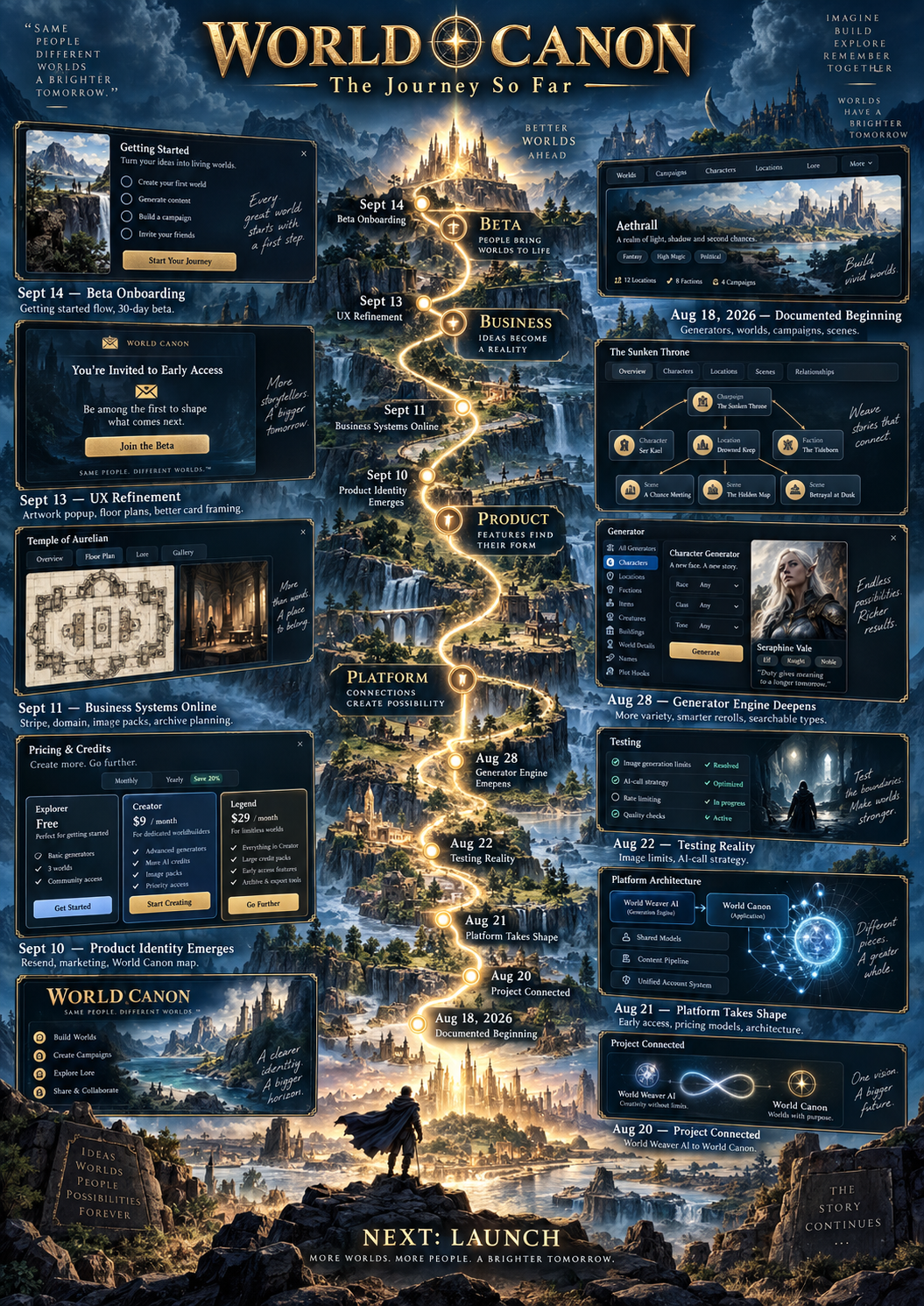 World Cannon / From Idea to Production
World Cannon became our first app to go from idea to production in 30 days
Source: Rob’s World Cannon beta launch notes and Storm’s beta walkthrough, September 2026.
Summary: World Cannon, our AI RPG worldbuilding app, reached beta this week. You can check it out at worldcanon.app. The important part is not just that it exists. It is that it went from idea to production in 30 days and gave us a real product loop to test: world creation, campaign creation, characters, scenes, library views, tester invites, and bug discovery.
Storm tested it as a real beta user, created a world, built a campaign, added characters, and saved a scene. The creative generation was strong enough to feel immediately useful at the table. The main blocker before wider beta is the relationship/linking system: worlds, campaigns, characters, and scenes need to connect cleanly so the product feels like a living canon, not a set of separate outputs.
Why it matters
This is what AI-assisted product building should feel like when it is working: not months of theorizing, not a pitch deck, not another demo. A real app, real testers, real defects, and a clear next iteration. The launch also gives us a concrete proof point for the broader AI Journey: the goal is not to talk about building with AI. The goal is to ship useful things.
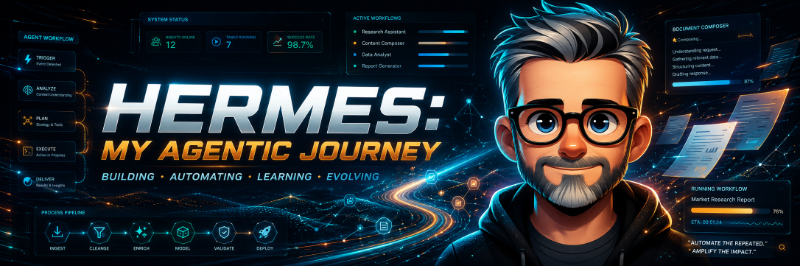 Field Notes / Hermes Journey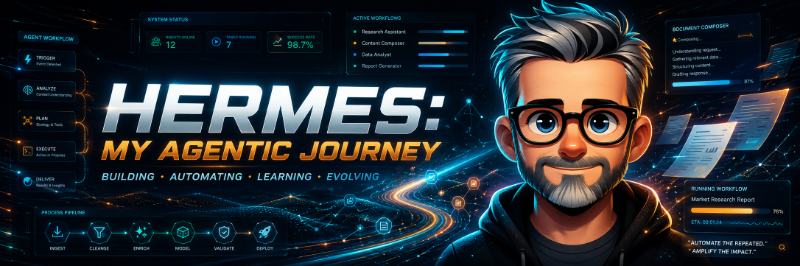
Field Notes from My AI Workstation: the agent colony made the work visible
This week was a reminder that the interesting AI work is rarely one clean magic trick. It is the operating layer: backups, upgrades, dashboards, retries, visible status, human review, and knowing when a system is telling the truth.
Storm went through a safe Hermes upgrade, cleaned up the local system, reduced a large session database, restored the gateway and local surfaces, tightened the AI Revolution publishing cadence, and kept improving Command Central. Then we added something more visual: a Luminor Agent Colony, adapted from Jarren Rocks’ Bot Crossing concept, so the sessions and agents can be seen as a working system instead of a pile of invisible logs.
That may sound cosmetic. It is not. Once you can see the colony, source filters, the “Needs Rob” lane, and the honest Alex / ChatGPT placeholder, the system gets easier to manage. It shows which agents are live, which sources are connected, and which parts are still only manual or browser-connected. That honesty matters.
The lesson for business leaders is simple: if your AI work is invisible, you cannot manage it. If your agents, automations, approvals, and errors only exist in scattered chats and hidden logs, you do not have an AI operating model yet. You have activity.
If your team is experimenting with AI, the next step is operating discipline.
AI education is not just teaching people which button to click. It is helping leadership teams understand access, governance, workflow fit, review loops, and where AI should not act without a person.
Keep reading on AI Revolution
The AI Revolution Blog is where these ideas live between issues. You can read past Found Friday posts, follow the Hermes Journey as it develops, and find practical notes on AI adoption, governance, workflows, and the human side of using these tools well.
Browse Found Friday back issues · Follow the Hermes Journey · Read more AI Revolution articles
Want to build your own practical AI workstation? My beginner-friendly Hermes guide walks through the mindset, setup, safety boundaries, and first workflows for a personal AI assistant.
AI does not become useful because it can do more. It becomes useful when the business can see the work, trust the process, and stop the system when judgment is required.
Closing Thought
The next phase is not about collecting more AI tools. It is about building the operating layer around them. That means access rules, clear owners, source-of-truth data, visible dashboards, approval points, logs, and a human who still knows what good looks like.
If that sounds boring, good. Boring is where AI starts becoming dependable.